
Importance of Newborn Stimulation
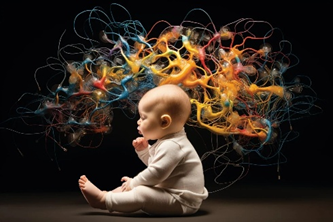
Newborn stimulation plays a vital role in your baby’s early brain development and future learning abilities. From birth, a baby’s brain cells multiply rapidly, forming millions of neural connections that build the foundation for thinking, memory, language, and emotional growth. These connections are strengthened through sensory experiences such as sound, sight, touch, taste, and smell.
Parent interaction with a newborn should begin from day one. Talking, singing, cuddling, and engaging in simple sensory activities not only support cognitive development but also strengthen the emotional bond between you and your baby. Understanding when your baby is ready for stimulation and how their senses develop during the first months of life helps parents provide meaningful, age-appropriate experiences.
In this guide, we explore the importance of newborn stimulation, how babies develop their senses, and simple sensory activities for babies aged 0–6 months.
- A baby’s brain cells will multiply rapidly during the 1st year of life, forming a network which is the key to thinking and lays the foundation for future learning. It is mainly dependent on the external stimulation he receives by sound, sight, touch, taste and smell, which will shape their understanding of the world around them.
- Interacting with them through various sensory activities will strengthen the bond between you and your little one as well.
When is Your Baby Ready for Stimulation?
During the first few weeks of life, your baby will spend most of his time sleeping. But as days pass by, the time he stays awake and alert will expand.
There will be times he’s awake but fussy and crying, mostly due to hunger, tiredness or feeling sleepy. Grabbing their attention would be difficult at this point. However, there are times the baby is fed, happy and showing interest in his surroundings. This is the time we should interact with them.

The Senses of the Newborn
From birth, your baby will embark on a journey of discovery and understanding the world through different senses.
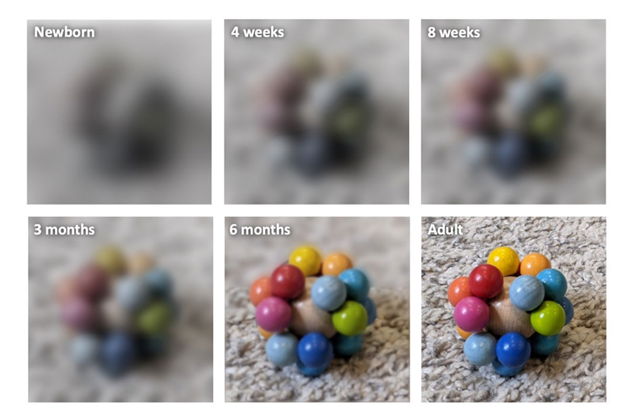
- Vision – Your baby’s vision will start blurry but will begin to focus on faces, bright objects and colours by the age of 3 months.
- Hearing – From birth, a baby may recognise familiar voices, especially their parents. And with time, their hearing will sharpen.
- Touch – This is the most developed sensation at birth, where the baby will use to explore his surroundings, reaching out for the mother’s comfort.
- Smell and Taste – Since birth, your baby will show preferences to certain scents and flavours, like the sweet taste and smell of breast milk.
Sensory Activities for Newborn Stimulation of Babies 0-6 Months Old.
Stimulation of hearing:
- Talk in baby language and laugh to your baby, making good eye contact.
- Sing or play lullabies or soft classical music that is fitting for newborns.
- Make funny noises and smile while looking at your baby’s face.
- Shake a rattle and allow your baby to locate the source of the sound.
- Read stories to your baby.

Visual Stimulation
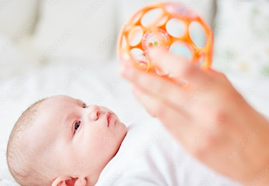
- Show a colourful toy, especially red, yellow or gold, closer to the baby’s eyes and move it horizontally in an arc, allowing the child to fix and follow the object, an ability that will develop around 3 months of age. This can be done in the prone position as well.
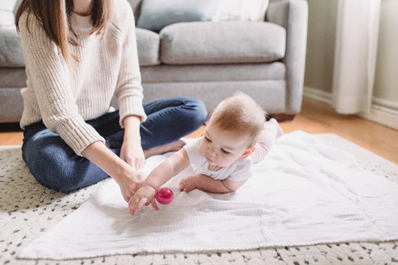
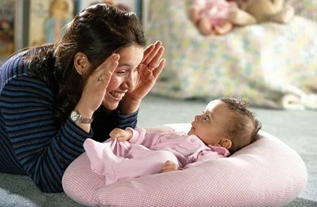
- Their range of sight is just a foot. So, bring your face and colourful objects as close as possible.
- Make funny faces with funny noises while maintaining good eye contact with the baby.
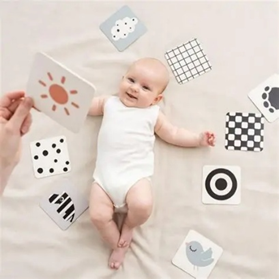
- Use high contrast cards with black, white and red colours. Hold them about 12inches above your baby’s face and move them from side to side.
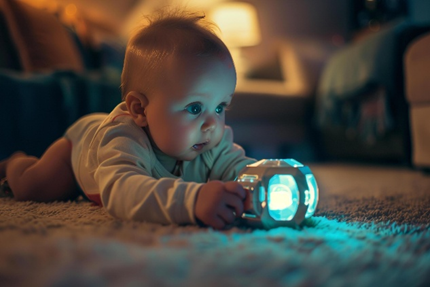
- Take the baby to a dark room or during nighttime, show objects that illuminate, encouraging them to focus on the object.
- Show shiny objects to infants, like shiny necklaces or colourful lit-up balls.
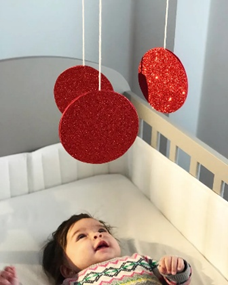
- Hang a colourful mobile with good contrast above your baby’s crib. Place it 12 inches above the baby’s face for optimal viewing.
- Show pictures in bright single colour on a white, clear background to the baby often.
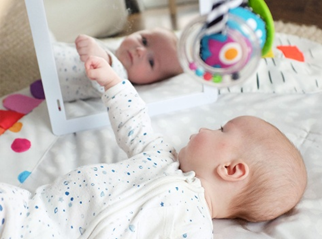
- Hold your baby in front of the mirror and point to your and their reflection (mirror play). This will boost their self-awareness.
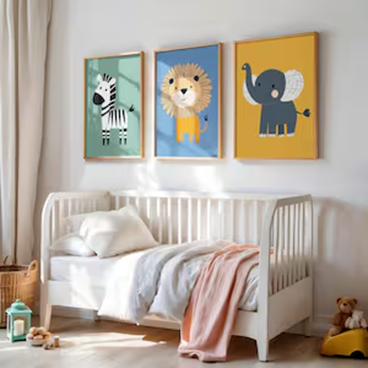
- Paste big stickers on the wall that are simple and have good contrast with a few colours like blue, red, green and yellow.
- Explore outside with your baby. Go for a walk in the park with your baby in the stroller.
Stimulation of Touch
- Skin to skin contact will stimulate touch sensation as well as regulate the baby’s temperature and heart rate, reduce stress and promote bonding.
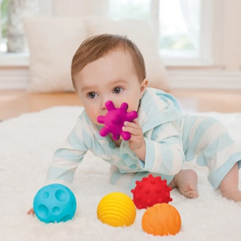
- Give toys and clothes of different textures for the baby to feel in his palm. Ex: soft toy, a towel with a rough surface.
- Massage your baby’s arms and legs with gentle strokes as a daily routine.
- Massage your baby’s arms and legs with gentle strokes as a daily routine.
- Give rattles or toys of lightweight and different textures for them to grasp and feel.
Coordination of Hand and Eye Movements
- Encourage the baby to look at a toy and reach out for it while lying to the side.
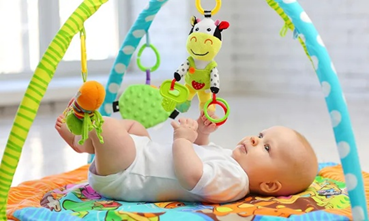
- When the child is lying on his back, encourage him to touch the toy by lifting both hands and legs.
- Lie the baby down in a baby gym where the baby could reach out to colourful toys hung with a string from above.
Stimulation of Taste and Smell
- Breastfeeding in a quiet place allows the baby to focus on the tastes and smells associated with feeding. It is a rich input of both taste and smell.
- Introducing safe scents: Leave a cloth with a few drops of mild, natural scents like vanilla or lavender in the baby’s room. Never apply them to a baby’s skin.
Tips for Sensory Play
- Remember that every baby will respond to these simulations uniquely and differently.
- Always keep an eye on their reactions and encourage them.
- If they don’t seem to be interested in sensory play, don’t force them.
- Incorporate these sensory activities into your daily routine.
- Talk to them while changing diapers, bathing and dressing.
- If they become fussy or show signs of overstimulation, it’s time for a break.
- Start with shorter sessions and extend the duration as your little one grows older.
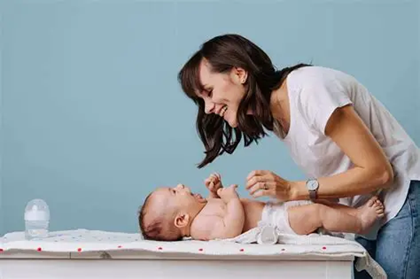
Newborn stimulation is not about complex toys or structured programs — it is about consistent, loving interaction. Through simple daily activities such as talking, skin-to-skin contact, gentle massage, singing, and visual play, parents can significantly support their baby’s sensory development and brain growth during the first year of life.
Every baby responds differently to stimulation, so observing their cues and avoiding overstimulation is essential. By incorporating short, engaging sensory activities into everyday routines, parents can help lay a strong foundation for cognitive development, emotional bonding, and lifelong learning.
Early sensory experiences truly shape how your baby understands the world, and your interaction is the most powerful tool of all.
